Twelve people, or sixty. Several vehicles, one dispatcher, one running order, and a list with every name on it so the count at the far end matches the count at the start.
Eight to sixty passengersSUVs and 14-seat SprintersOne desk holds the whole run
01 — What it is
Past seven passengers, a booking becomes a schedule.
Group transportation is the word for a job that will not fit into one vehicle. Below seven passengers you are booking a car. Above it you are booking a movement: two or three vehicles leaving from different addresses, arriving in an order somebody has decided on, and one desk keeping track of which of them is where.
The run is the unit, not the car. A group run is quoted as a whole — every vehicle, the hours each one is committed for, and the staging time in between — then confirmed in writing as one figure with the vehicles itemised beneath it. Nobody has to reconcile four separate bookings afterwards.
Somebody has to own the list. That somebody is us. Names are set against vehicles before the day, and each chauffeur carries the part of the list that concerns him. When a head count comes up short at the second stop, the answer is already on paper instead of being shouted across a car park.
Scale is what makes this dull. Ninety-nine vehicles across six classes is not a boast about size; it is the reason the class you booked is the class that turns up when the run needs four vehicles on a Saturday in June. One workshop schedule, one standard of upkeep, and any replacement drawn from the same fleet rather than from somebody else's.
Who books it
Wedding parties. The bridal party in one vehicle, parents in another, guests leaving in waves after midnight. The day-specific version is wedding transportation.
Conference and offsite organisers. Hotel to venue, venue to dinner, dinner back to the hotel, repeated for two days. Those days live under corporate events.
Production and crew calls. Eleven names on a call sheet and a five o'clock start that cannot move by ten minutes.
Families arriving together. Three flights landing inside the same hour, one house to reach, and grandparents who should not be waiting on a kerb.
Festival groups. Six out on the Friday, ten back on the Sunday, and a long desert leg in between — Coachella and Stagecoach weekends.
Clubs, teams and supporters. Match-day movements around the city where somebody else has fixed the arrival window and it is not negotiable.
If the whole party fits in one vehicle you want Sprinter van service instead: fourteen seats, one arrival, no staging to think about. The full list of fifteen services shows where that line falls.
02 — How the run holds together
The four parts of a group run you never see.
Not one of them is visible from the back seat, and all four are what the booking is actually paying for.
6Vehicle classes to mix
99Vehicles behind one booking
14Seats in the largest vehicle
24/7One number, any hour
The manifest
Ahead of the day you receive a list: every name, the vehicle it travels in, the pickup address and the time. You correct it, we work to it. Each chauffeur is sent only the part that concerns him, so nobody is reading fifty names at a kerb to find four.
Staggered departures
Vehicles seldom leave together, because venues seldom have kerb space for four at once. Departures are spaced so that arrivals land in the order the schedule needs: whoever has to be there first goes first, and the rest are timed behind them.
A lead vehicle
One vehicle is nominated as the lead, and it usually carries whoever is making the decisions. Its chauffeur is the first person dispatch speaks to when something changes, and the other chauffeurs take their timing from that vehicle rather than from a group chat.
One desk, not four drivers
(323) 799-3190 reaches the dispatcher holding the whole run, at any hour. One call moves every vehicle in it. Your side of the arrangement is a single number to ring and a desk that already knows what the day is meant to look like.
Fourteen passengers in one vehicle
03 — The late guest
Somebody is always late. That is planned for, not panicked over.
It happens on almost every run of more than a dozen people, and rarely for the same reason twice. One guest is still upstairs. A flight lands twenty minutes down. A group is finishing a photograph nobody put in the plan. The question is never whether it will happen; it is who decides what to do in the ninety seconds afterwards.
The other vehicles do not wait for a name. Holding three loaded vehicles for one passenger converts one late guest into forty. The chauffeur marks the name, reports it and leaves on the departure time unless dispatch says otherwise — and dispatch says otherwise only if you have told us the run cannot begin without that person.
A latecomer becomes a second pickup. Where a vehicle is close enough, we bring the guest on separately and put them into the run at the next stop. Where there is nothing close, dispatch tells you what a separate car costs before one is sent, so the choice is yours and you make it with the figure in front of you.
Waiting is never a mystery charge. Each vehicle carries an allowance and each allowance is stated on your confirmation. Airport pickups are where we can be exact in advance: LAX arrivals carry thirty minutes of complimentary waiting from the moment the aircraft is on the ground, not from the time printed on the ticket.
Where the end of the day is genuinely unknown, hourly and as-directed work keeps each vehicle with the group instead of releasing it after a leg. The arrivals side is set out in full on LAX transfers.
04 — Vehicles and capacity
Every class, and what it actually seats.
Six classes, and at the planning stage only one number matters: how many people sit in each of them. Do the arithmetic before you ring and the call takes two minutes.
Vehicle class against seated passenger capacity
Vehicle class
Seated passengers
Where it sits in a group run
Mercedes-Benz S-Class
3
A principal travelling apart from the group, or the couple
BMW X5
4
Four people travelling light; often the follow car
GMC Yukon Denali
6
Six adults kept together on a longer leg
Cadillac Escalade ESV
6
Six with luggage, or the parents-and-grandparents vehicle
Chevrolet Suburban
7
The workhorse: seven seats and a boot that still closes
Mercedes-Benz Sprinter
14
The bulk of the group, moving to one place at one time
The table scrolls sideways on a narrow screen.
Full-size SUV
Chevrolet Suburban
The vehicle most group runs are built around. Seven seats, a boot deep enough that nobody travels with a case on their knees, and a step-in height that older passengers manage without help.
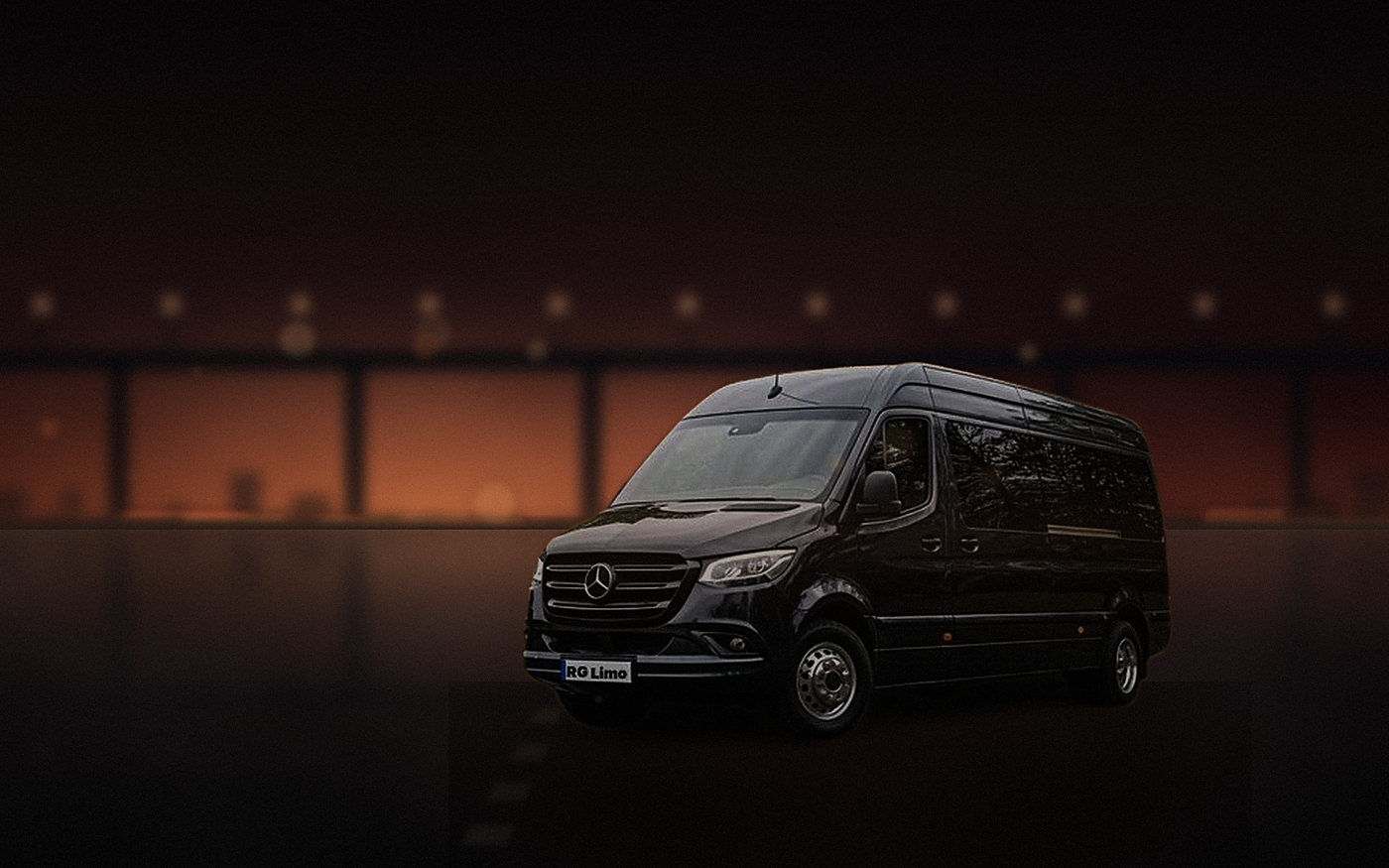
The Mercedes-Benz Sprinter is the largest single vehicle we run, at fourteen seats. Inside a group run it takes the people who are all going to the same place at the same time, while the SUVs carry those whose timings are different — the couple leaving early, the two who arrive on a later flight, the family that has to be at the venue before everyone else.
Booked on its own for eight to fourteen people, it has a page of its own: Sprinter van service.
The arithmetic is worth doing before you ring. Twenty people is a Sprinter and a Yukon Denali, exactly. Sixty-three seats is four Sprinters and a Suburban. What is available on your particular date is confirmed when we quote rather than assumed — all six classes are set out on the fleet page.
Twenty-six of us across two vans from a hotel in Anaheim to a dinner in Newport. Both vehicles left together and arrived together, which sounds obvious and has not been my experience with other companies.
Owen R.Conference group, twenty-six
05 — Pricing, in the open
Hourly work starts from $85. A group run is priced vehicle by vehicle.
Published figures are starting points, not a rate card pretending every group is the same size. The number that counts is the one on the written quotation you accept.
How many vehicles. The first lever and the largest one. Twelve people in a single Sprinter is one vehicle for one block of time. Twelve people leaving from four different addresses is three or four vehicles, most of them half empty, and it costs accordingly. That is why we ask where everybody is starting from before quoting anything.
Which classes they are. The smallest class sets the floor at $85 an hour. Larger vehicles cost more, in the order you would expect: SUV above sedan, Sprinter above SUV. A mixed run is those figures added together, one line per vehicle, so you can see what each part of the group is costing.
Hours, or legs. One movement — everybody from the hotel to the venue, once — is quoted as a leg. A day where the vehicles stay with the group, wait outside lunch and take them on again is hourly work. Past two movements hourly is usually the cheaper of the two, and we will tell you when that is the case.
Whether a set fare covers part of it. Airport legs often do. Beverly Hills, Santa Monica and Hollywood to LAX start from $125; Malibu, Newport Beach and Irvine from $150; LAX to San Diego from $525. Those figures are per vehicle and they replace the hourly rate on that leg instead of adding to it. All ten are listed on set-price routes.
What the venue charges. Tolls and venue parking are passed through at cost and itemised. Hotels and event car parks sometimes charge per vehicle admitted, which on a four-vehicle run is worth establishing in advance rather than discovering underneath a total.
No surge. A figure agreed in March for a June wedding is the figure in June, whatever the date turns out to be doing.
No charge for the conversation. Quoting a run with four vehicles in it takes a phone call and some arithmetic. That is our side of the work, not a line on your invoice.
Gratuity is never added quietly. Ask for it on the invoice and it goes on. If the group would rather hand it over on the night, that is equally fine.
The vehicles you booked. Same cars, same chauffeurs, held to the run. If a mechanical fault forces a substitution you hear which vehicle is replacing it from us, before it arrives.
One quotation, in writing. Everything above stays a starting point until it is written down. Nothing reaches a card that was not on that page or agreed with you afterwards.
Answers from the desk that would take the call. Nothing here changes once you have a written confirmation, because the confirmation restates it.
How many people can you move on one booking?
There is no fixed ceiling. Capacity is arithmetic: seven passengers to a Suburban, fourteen to a Sprinter, and however many vehicles the date can support. Give dispatch the head count, the pickup addresses and the time everyone has to be somewhere, and you get back a vehicle mix and one price for the whole run.
Do all the vehicles arrive at the same time?
Rarely, and usually on purpose. Most venues have room for one or two vehicles at the kerb, so departures are staggered to make arrivals land in the order you want them in. That order is agreed with you beforehand rather than sorted out in a car park.
Who do we call on the day?
Dispatch, on (323) 799-3190, answered at any hour. One desk holds the whole run, so a single call moves every vehicle in it. You are not ringing four chauffeurs to work out where the third van went.
What happens if one of our guests is late?
The chauffeur marks the name off the manifest and dispatch decides in the moment: hold that vehicle, move the guest onto a later one, or send a separate car. Anything that costs money is quoted to you before it is dispatched, and the wait each vehicle carries is stated on your confirmation.
Is a group run priced per person or per vehicle?
Per vehicle, for the time that vehicle is committed. Hourly work starts from $85 an hour on the smallest class and rises with the size of the vehicle, so a mixed run is a set of vehicle prices added together rather than a head count multiplied by a fare.
Can part of the group come straight from the airport?
Yes, and it is often the cheaper way to do it. LAX arrivals carry thirty minutes of complimentary waiting from the moment the aircraft lands rather than from the time on the ticket, and set fares cover the common runs: from $125 for Beverly Hills, Santa Monica or Hollywood, and from $150 for Malibu, Newport Beach and Irvine.
Something here not covered? Put it to the office and you will get a straight answer, including when the answer is that a figure has to wait for the confirmation.
07 — Reserve
Send us the head count and the deadline. We will build the run around it.
Numbers, addresses, the hour everybody has to be inside. That is enough to come back with a vehicle mix, a departure order and one figure in writing.